Template vs. Custom Website Design: Which Is Right for Your Small Business?
Compare website templates and custom design for positioning, SEO, performance, conversion paths, flexibility, and long-term growth.
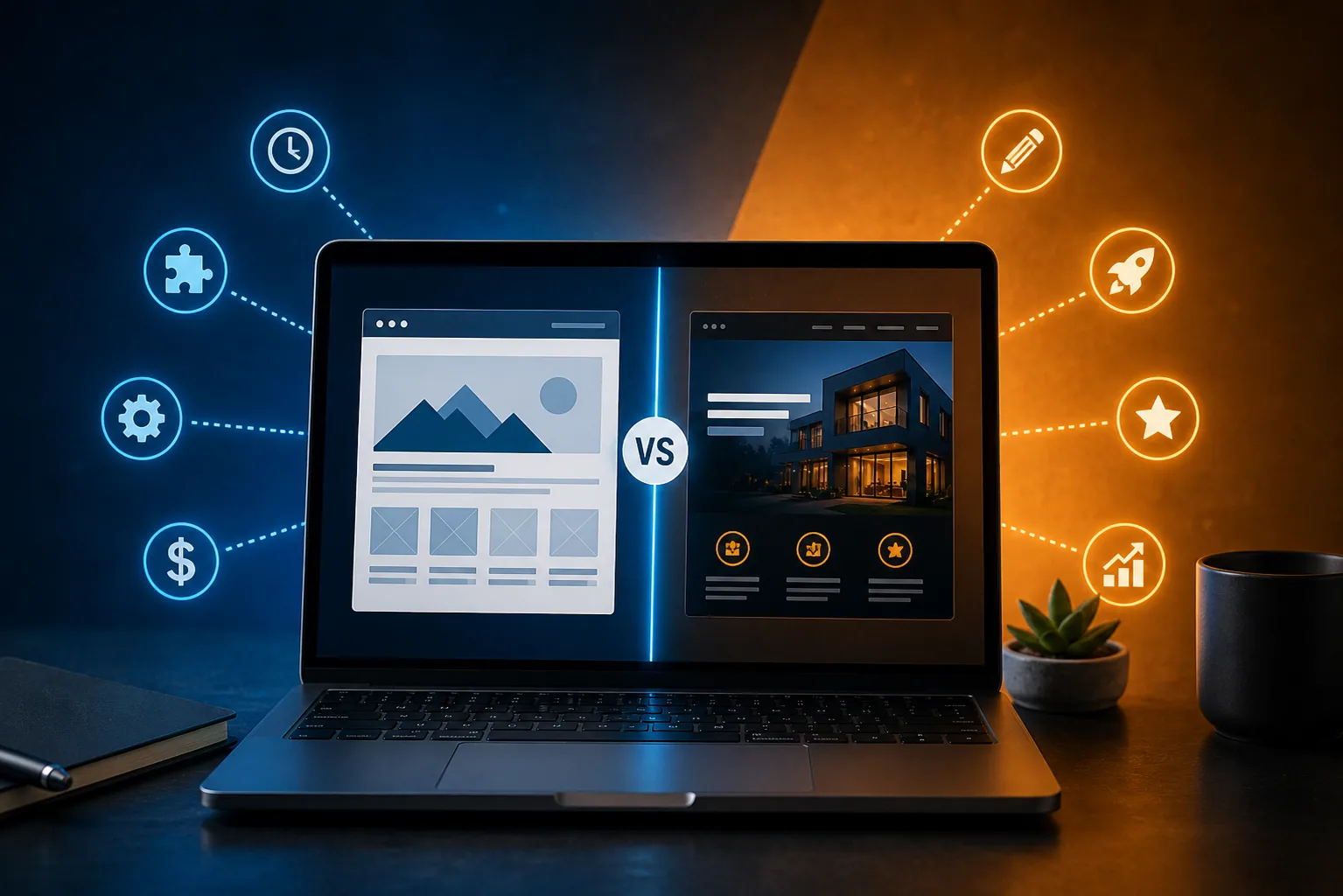
Choosing between a website template and custom web design isn't just a design decision.
It's a business decision.
A template can help you get online quickly. A custom website can give your business a stronger foundation for search visibility, lead generation, conversion, performance, and long-term growth.
The right choice depends on where your business is now, what the website needs to do, and how much flexibility you'll need later.
For some small businesses, a simple template is enough. For others, a template quickly becomes limiting because the business needs better service pages, stronger calls to action, cleaner SEO structure, faster mobile performance, ecommerce, automation, or a more unique brand experience.
This guide will help you compare both options so you can make a practical decision instead of choosing based only on price or appearance.
If your website needs to generate leads, explain services clearly, support local search, and connect to follow-up, SiteBuilder Design’s small business website design approach is built around clarity, performance, conversion paths, and long-term growth.
Quick Answer: Templates vs. Custom Web Design
A template website is usually best when you need a simple online presence, have a small budget, and don't need much customization.
Custom web design is usually best when the website needs to support a real business strategy, stronger branding, local SEO, lead generation, ecommerce, AI readiness, or a more flexible customer journey.
The real question isn't “Which one is cheaper?”
The better question is:
What does the website need to do for the business?
If the site only needs to show basic information, a template may be fine.
If the site needs to attract, explain, convert, track, and support follow-up, custom design is often the stronger investment.
What Is a Website Template?
A website template is a pre-designed layout that can be customized with your own logo, colors, images, text, and pages.
Templates are common on platforms like WordPress, Wix, Squarespace, Shopify, Webflow, and many AI website builders.
A template usually gives you a starting structure, such as:
- Homepage layout
- About page
- Services page
- Contact page
- Blog layout
- Gallery or portfolio section
- Product page layout
- Header and footer styles
Templates can be helpful because they reduce the amount of design and development work needed at the beginning.
But the tradeoff is that your site has to fit inside the template’s structure, unless someone customizes it carefully.
What Is Custom Web Design?
Custom web design is built around the business instead of forcing the business into a pre-made layout.
A custom website may still use a CMS, theme, framework, or reusable components, but the strategy, structure, design, content, and user flow are planned around your actual goals.
Custom web design can include:
- Clearer homepage messaging
- Service-specific page structure
- Custom visual direction
- Local SEO planning
- Conversion-focused calls to action
- Mobile-first layout decisions
- Faster performance planning
- Contact forms and booking paths
- Ecommerce workflows
- AI chatbot or automation readiness
- Analytics and tracking setup
- Content strategy and internal linking
The goal isn't to make the website custom just for the sake of being custom.
The goal is to build a website that fits the business, the customer journey, and the actions you want visitors to take.
SiteBuilder Design’s website packages are built around outcomes like credibility, speed, local SEO, clear action, lead capture, ecommerce, automation, and future growth.
When Website Templates Are Fine
Templates aren't automatically bad.
A template can be the right choice when the website has a simple job and the business doesn't need a highly customized experience.
A template may be fine if:
- You're just starting and need a basic online presence.
- The site only needs a few simple pages.
- You don't need advanced SEO structure.
- You don't need complex service pages.
- Your budget is very limited.
- You're testing a new idea or temporary offer.
- Your business doesn't depend heavily on website leads.
- You're comfortable with a site that looks similar to others.
- You can update the content yourself.
For example, a one-page website for a temporary event, simple personal page, basic landing page, or early-stage side project may not need custom design.
In those cases, the most important thing is to keep the site clear, mobile-friendly, fast, and easy to act on.
Template website checklist
A template may be enough if you can answer “yes” to these questions:
- Is the website mostly informational?
- Do you only need a small number of pages?
- Is the business offer simple to explain?
- Can the template support your main call to action?
- Does it work well on mobile?
- Does it load quickly?
- Can you edit it without breaking the design?
- Are you okay with limited layout flexibility?
If the answer is yes, a template may be a reasonable starting point.
When Templates Become Limiting
Templates often become frustrating when the business starts needing more than a basic online presence.
The site may look acceptable at first, but problems show up when you need better content structure, stronger SEO, more specific service pages, custom forms, faster performance, or a more unique brand experience.
A template may become limiting if:
- Every service page looks the same.
- The homepage doesn't explain the business clearly.
- You can't place calls to action where they should go.
- The mobile layout is difficult to control.
- The site feels generic or interchangeable.
- You're fighting the builder to make simple changes.
- The template includes bloated scripts, plugins, or animations.
- Important SEO settings are hard to manage.
- You can't create the right page structure for your services.
- You need integrations with forms, booking, email, ecommerce, CRM, or AI tools.
This is where a cheap website can start costing more than expected.
The problem isn't always the template itself. The problem is using a template as a substitute for strategy.
If your site already feels outdated, difficult to use, or disconnected from your business goals, read 5 Signs Your Small Business Website Needs a Redesign before deciding whether to patch the current site or rebuild it.
When Custom Website Design Is Worth It
Custom web design is worth considering when the website needs to do more than exist.
It becomes more valuable when the site needs to support visibility, trust, lead capture, conversion, ecommerce, automation, or long-term growth.
Custom design may be worth it if:
- Your website is a major source of leads.
- You need stronger service pages.
- Your business serves multiple audiences or locations.
- Your current site looks generic or outdated.
- You need better local SEO structure.
- You want clearer conversion paths.
- You need ecommerce or product workflows.
- You want AI chat, automation, booking, or CRM integration.
- You need better performance on mobile.
- Your brand needs to stand apart from competitors.
- You want a site that can grow over time.
A custom website gives you more control over the customer journey.
Instead of forcing your message into a layout that was made for everyone, you can build the site around the specific questions your customers ask, the services you want to sell, and the actions you want visitors to take.
A custom small business website should answer:
- What does the business do?
- Who does it help?
- Why should someone trust it?
- What service or offer should a visitor choose?
- What proof supports the claim?
- What should the visitor do next?
- How will the business follow up?
That's where custom design becomes a business tool, not just a visual upgrade.
Hidden Costs of Cheap Websites
A cheap website can be the right move if expectations are realistic.
But cheap websites often become expensive when they create problems that have to be fixed later.
Hidden costs can include:
- Weak messaging that doesn't convert visitors
- Generic design that fails to build trust
- Slow load times from bloated templates or plugins
- Poor mobile usability
- Missing SEO foundations
- Limited service-page structure
- No clear call to action
- Forms that are hard to track
- Difficult content updates
- Extra costs for plugins, apps, or add-ons
- Rebuild costs when the site can't grow
- Lost leads from unclear user experience
The biggest cost isn't always what you paid to build the site.
The bigger cost is what the site fails to do.
If the website doesn't explain your offer, support SEO, build trust, or guide people toward action, it can quietly leak opportunities every month.
For a deeper audit-style breakdown, see Top Website Mistakes Small Businesses Make Before Hiring a Web Designer.
SEO and Performance Differences
Templates and custom websites can both perform well or poorly.
A template isn't automatically bad for SEO, and custom design isn't automatically good for SEO.
What matters is how the site is planned, built, written, optimized, and maintained.
Template SEO challenges
Template websites can run into SEO issues when they have:
- Generic page titles
- Thin service pages
- Duplicate layouts with little original content
- Poor heading structure
- Bloated code or plugins
- Slow mobile performance
- Weak internal linking
- Image-heavy pages with little text
- Limited control over structured data
- Poor URL structure
Custom SEO advantages
A custom website can make SEO easier when it includes:
- Search-focused site structure
- Clear service pages
- Local SEO planning
- Strong metadata
- Internal linking between related pages
- Fast mobile performance
- Optimized images and media
- Schema markup where appropriate
- Buyer-question content
- Clean navigation
- Analytics and Search Console setup
Search engines need to understand what each page is about, who it's for, and how it relates to the rest of the site.
That's why SiteBuilder Design’s SEO services focus on technical structure, metadata, internal links, service pages, Google Business Profile alignment, and content that answers real buyer questions.
Performance matters too
Performance isn't just technical polish.
A slow site can hurt user experience, trust, and conversions.
Template sites can become slow when they rely on heavy page builders, too many plugins, oversized images, unnecessary animations, or third-party scripts.
Custom sites can be built more intentionally around performance, but they still need disciplined image handling, clean code, good hosting, and careful testing.
The best website isn't the one with the most effects. It's the one that loads quickly, explains the offer clearly, and helps visitors act.
AI-Generated Website Builders and Why Many Sites Look the Same
AI-generated websites are becoming more common.
They can be useful for quick prototypes, early drafts, landing page ideas, and simple starting points. But many AI-generated sites have the same problem as basic templates: they look polished at first glance but feel generic when you look closer.
Common issues include:
- Similar layouts across many sites
- Generic gradients, cards, and icons
- Vague copy that could apply to any business
- Weak service-page depth
- Thin local SEO signals
- Unclear conversion paths
- Little brand distinction
- Overused animation patterns
- Missing business-specific proof
- Content that sounds impressive but says very little
This matters because customers can feel when a site is generic.
A small business website should not look like it was assembled from the same visual patterns as dozens of other AI-generated websites in the feed.
AI can help speed up planning, drafting, content organization, and design exploration. But it still needs human strategy.
A strong website needs business-specific positioning, real proof, useful service content, local relevance, clear calls to action, and a follow-up path.
AI can assist with that process, but it should not replace the thinking behind it.
Template vs. Custom Web Design Comparison
| Category | Template Website | Custom Website Design |
|---|---|---|
| Upfront cost | Usually lower | Usually higher |
| Launch speed | Faster for simple sites | Longer because strategy and structure are planned |
| Visual uniqueness | Limited unless customized carefully | Built around the brand and business goals |
| Content strategy | Often added after the layout | Planned around services, customers, and conversions |
| SEO flexibility | Depends on platform and setup | Can be structured around search goals from the start |
| Performance | Can be good, but often affected by bloated themes, plugins, or scripts | Can be optimized more intentionally |
| Mobile experience | Depends on the template | Planned around real visitor behavior |
| Conversion paths | Often generic | Built around calls, forms, booking, quotes, sales, or follow-up |
| Scalability | Can become limiting as needs grow | Easier to expand around future services or features |
| Best for | Simple sites, temporary pages, small budgets, quick launches | Businesses that need leads, SEO, brand clarity, ecommerce, automation, or growth |
The best choice depends on the job the website needs to do.
If the website is only a basic placeholder, a template may be enough.
If the website needs to support marketing, sales, search, trust, and follow-up, custom design is usually the stronger long-term choice.
Decision Checklist: Template or Custom?
Use this checklist to decide which option fits your business.
A template may be enough if:
- You need a simple site quickly.
- You only need a few basic pages.
- Your business doesn't rely heavily on website leads.
- You have a limited budget.
- Your services are simple to explain.
- You're okay with a less unique design.
- You can work within the template’s limits.
- You don't need advanced integrations.
Custom design may be better if:
- Your website needs to generate leads.
- Your services need stronger explanation.
- Your business has multiple audiences, services, or locations.
- You need better local SEO.
- You want stronger brand differentiation.
- You need faster performance or cleaner structure.
- You want better calls to action.
- You need forms, booking, CRM, email, ecommerce, or AI integrations.
- Your current site feels generic, outdated, or hard to update.
- You want a site that can grow with the business.
Ask this before deciding
- What is the main job of the website?
- How important is search traffic?
- How important are leads or online sales?
- Does the business need to stand out visually?
- Will the site need to grow over time?
- Do you need integrations or automation?
- How much would a weak website cost in missed opportunities?
The right answer depends on your goals, not just your budget.
A Practical Middle Ground
The choice isn't always “cheap template” or “fully custom build.”
There's often a middle ground.
A small business can start with a structured package that uses efficient tools but still includes strategy, messaging, page planning, SEO basics, mobile performance, conversion paths, and future growth.
That's often the best option for businesses that need something stronger than a generic template but don't need a large custom project.
SiteBuilder Design’s website packages are designed for that middle ground: practical websites built around business outcomes, not just page count.
This can include:
- Better homepage structure
- Service-page planning
- Clear calls to action
- Local SEO foundations
- Mobile-friendly layouts
- Contact and lead capture paths
- Analytics setup
- Ecommerce or AI options where needed
The goal is to build the right system for the stage of the business.
Final Recommendation
Templates can be useful when you need a simple, affordable starting point.
Custom web design becomes more valuable when your website needs to explain your business clearly, rank in search, convert visitors, support follow-up, and grow with your services.
The risk with templates isn't that they're always bad. The risk is assuming a template can replace strategy.
The risk with custom design isn't that it costs more. The risk is paying for something custom that still doesn't solve the business problem.
The best website is the one that fits the job.
For some businesses, that means a clean template with careful content.
For others, it means a more strategic custom build designed around SEO, conversion, performance, and long-term growth.
If you're unsure which direction makes sense, SiteBuilder Design can help you evaluate your current site, goals, budget, and growth needs.
Start with small business website design, compare website packages, review common small business website mistakes, or check whether your current site shows signs it may need a redesign.
Contact SiteBuilder Design to plan the right website approach for your business.
Frequently Asked Questions
Are website templates bad for small businesses?
No. Website templates can be useful for simple websites, small budgets, quick launches, and early-stage businesses. The problem is when a template is used as a substitute for clear messaging, SEO structure, mobile performance, and conversion planning.
Is custom web design better than a template?
Custom web design is usually better when the website needs to support lead generation, SEO, ecommerce, brand differentiation, automation, or long-term growth. A template may be enough for simpler websites with limited goals.
Why do many template websites look the same?
Template websites often use similar layouts, sections, icons, card styles, and visual patterns. Without custom strategy, content, imagery, and design direction, many sites can feel interchangeable.
Are AI-generated websites good for small businesses?
AI-generated websites can be useful for quick drafts or prototypes, but they often need human strategy, editing, SEO planning, brand direction, and conversion improvements before they're ready to support a real business.
What are the hidden costs of cheap websites?
Hidden costs can include weak SEO, slow performance, poor mobile usability, generic copy, unclear calls to action, limited flexibility, plugin costs, rebuild costs, and missed leads.
Can a template website rank in Google?
Yes, a template website can rank if it has strong content, clear structure, good metadata, fast performance, mobile usability, internal links, and useful service pages. The template itself is less important than how well the site is built and optimized.
When should I choose custom web design?
Choose custom web design when your website needs to generate leads, explain services clearly, support local SEO, integrate with tools, stand out visually, improve performance, or grow with the business over time.
Does SiteBuilder Design offer both simple and custom website options?
Yes. SiteBuilder Design offers practical website packages and custom website support for small businesses that need stronger messaging, service pages, SEO foundations, conversion paths, ecommerce, AI readiness, and long-term growth.
Related service hub
Continue with Small Business Website Design
Plan a fast, modern, mobile-friendly website built around trust and conversion.
View the service hubNeed a clearer system?
Let’s make your website work harder.
SiteBuilder Design builds websites, SEO foundations, eCommerce flows, AI support, and follow-up systems that work together.